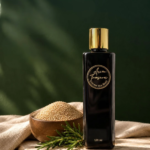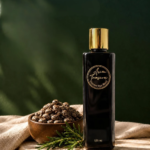
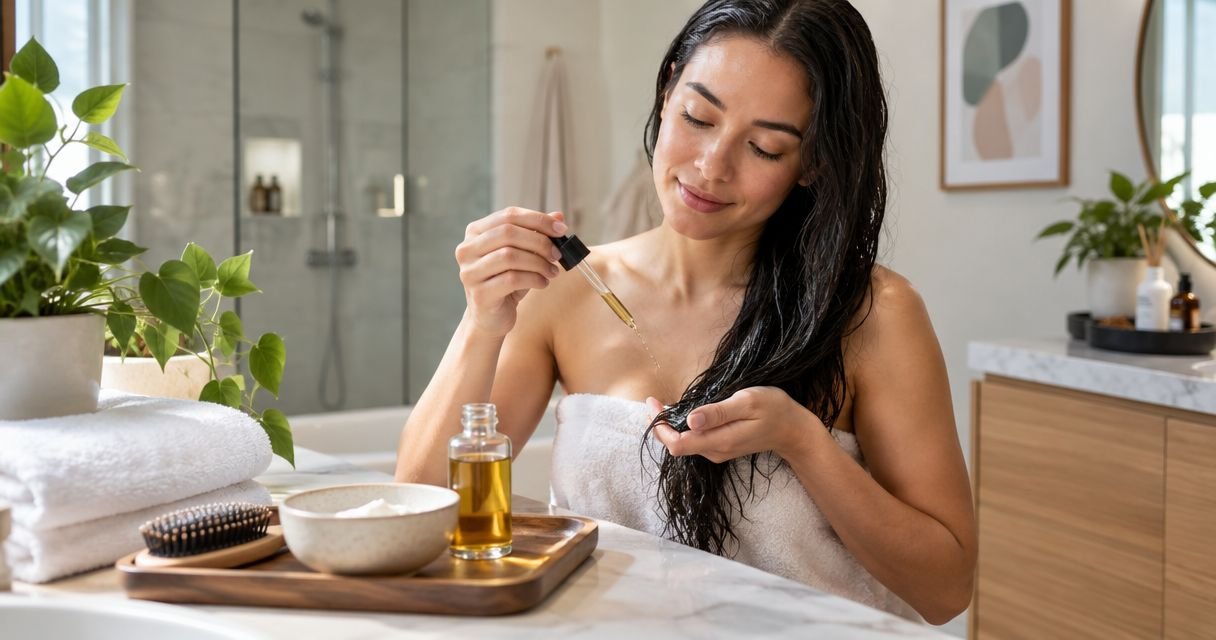
Instead of adding more oil whenever your hair feels dry after a mask, rinse the mask thoroughly, gently remove excess water, then use hair oil after hair mask only if its directions allow leave-in application. This workflow targets softer, more manageable lengths—not hair regrowth—and the guide to hair oil for dry hair explains the broader conditioning role.
- Use hair oil after hair mask only when the oil’s directions permit leave-in use.
- Apply the finishing oil to lengths and ends; scalp oiling is a separate decision.
- Asian Treasures offers botanical cosmetic hair care, not a treatment for medical hair loss.
- A hair mask and an oil finish serve different roles; more product does not guarantee better conditioning.
Why this matters
The right order is rinse-out mask first, leave-in-compatible oil last. A mask conditions the hair according to its formulation; a finishing oil adds lubrication and changes how the surface feels. Applying more oil cannot correct an incompletely rinsed mask or treat an irritated scalp.
The phrase sealed moisture is useful shorthand, not a guarantee. Oils differ, and a coating on the hair does not mean every formula prevents water loss equally. Judge the result by flexibility, detangling and residue—not by how oily your hair feels.
For your 2026 routine, separate cosmetic improvement from changes in hair density. Less snapping during styling concerns strand breakage; persistent shedding from the scalp needs a different assessment.
Asian Treasures hair oil is best suited to shoppers seeking traditional botanical cosmetic care, not medical hair-loss treatment. The traditional blend distinguishes the product's positioning; tradition alone does not establish effectiveness.
Before you start
- Gather the essentials: your hair mask, an oil with readable application directions, a clean towel and a suitable detangling tool. Follow any instructions specific to coloured or chemically treated hair.
- Check the non-obvious restriction: not every hair oil is a leave-in product. If the label requires washing it out, do not turn it into a finishing oil after your mask.
- Check skin tolerance before broader use: the American Academy of Dermatology recommends testing a new skin-care product on a small area twice daily for 7–10 days. Follow the product's directions, including rinsing requirements; a home test does not rule out every reaction.
Keep your starting routine simple. Introducing a new mask, oil and scalp treatment together makes it harder to identify which product caused irritation or an unwanted finish.
Choose the workflow before opening the bottle
These are application routes, not competing treatments. The best choice depends first on the product directions, then on how your hair responds.
| Workflow | Best for | Main benefit | Main limitation |
|---|---|---|---|
| Rinse-out mask, then leave-in-compatible oil | Lengths that still need lubrication after rinsing | Lets you assess the mask result before adding oil | Excess oil can leave a heavy or greasy finish |
| Pre-wash oil, shampoo, then rinse-out mask | Oils labelled for washing out | Keeps a wash-out oil within its intended routine | Adds a washing stage and does not replace the mask |
| Rinse-out mask without a finishing oil | Hair that already feels manageable after conditioning | Avoids unnecessary product layering | Does not add the surface feel of an oil finish |
Start with the least complicated route that leaves your hair manageable. Skipping an unnecessary finishing layer is a valid result, not an incomplete routine.
Mask rinse
- Read the mask directions. Confirm whether the product is rinse-out or leave-in. This workflow assumes a rinse-out mask; a leave-in mask needs its own label-led sequence.
- Complete the instructed application. Use the stated placement and contact time. Do not extend the treatment simply because your hair feels damaged.
- Rinse as directed. Work water through the lengths and areas where product collects. Do not deliberately leave a rinse-out mask behind to create a stronger conditioning effect.
- Assess the hair before adding anything. Notice whether the lengths feel manageable, heavily coated or difficult to separate. If obvious product remains, finish rinsing before moving on.
Expected result: the mask is rinsed out according to its directions, with no obvious pockets of product. Your hair is ready for gentle handling rather than another immediate coating.
A slippery feel alone does not prove that the mask remains unrinsed; conditioning products can change surface feel. Look for visible residue and follow the label instead of repeatedly washing until the hair feels stripped.
Gentle drying
- Squeeze out excess water gently. Avoid twisting the lengths tightly or rubbing them together.
- Blot with a clean towel. The American Academy of Dermatology's healthy-hair guidance recommends gentle drying rather than rough towel rubbing.
- Detangle according to your texture. Work carefully through the ends and move upward. Avoid forcing a brush through resistance; the Academy distinguishes wet-hair handling advice for straight hair from detangling advice for curly or tightly textured hair.
- Check the oil's moisture instructions. If the oil specifies damp or dry hair, follow that instruction. Do not assume every formula belongs on soaking-wet strands.
Expected result: your hair is no longer dripping, unnecessary friction is reduced, and the lengths are accessible for controlled application.
For a 2026 routine review, pay attention to handling as well as products. An elaborate oiling ritual cannot compensate for repeatedly pulling through tangles or rubbing fragile lengths aggressively.
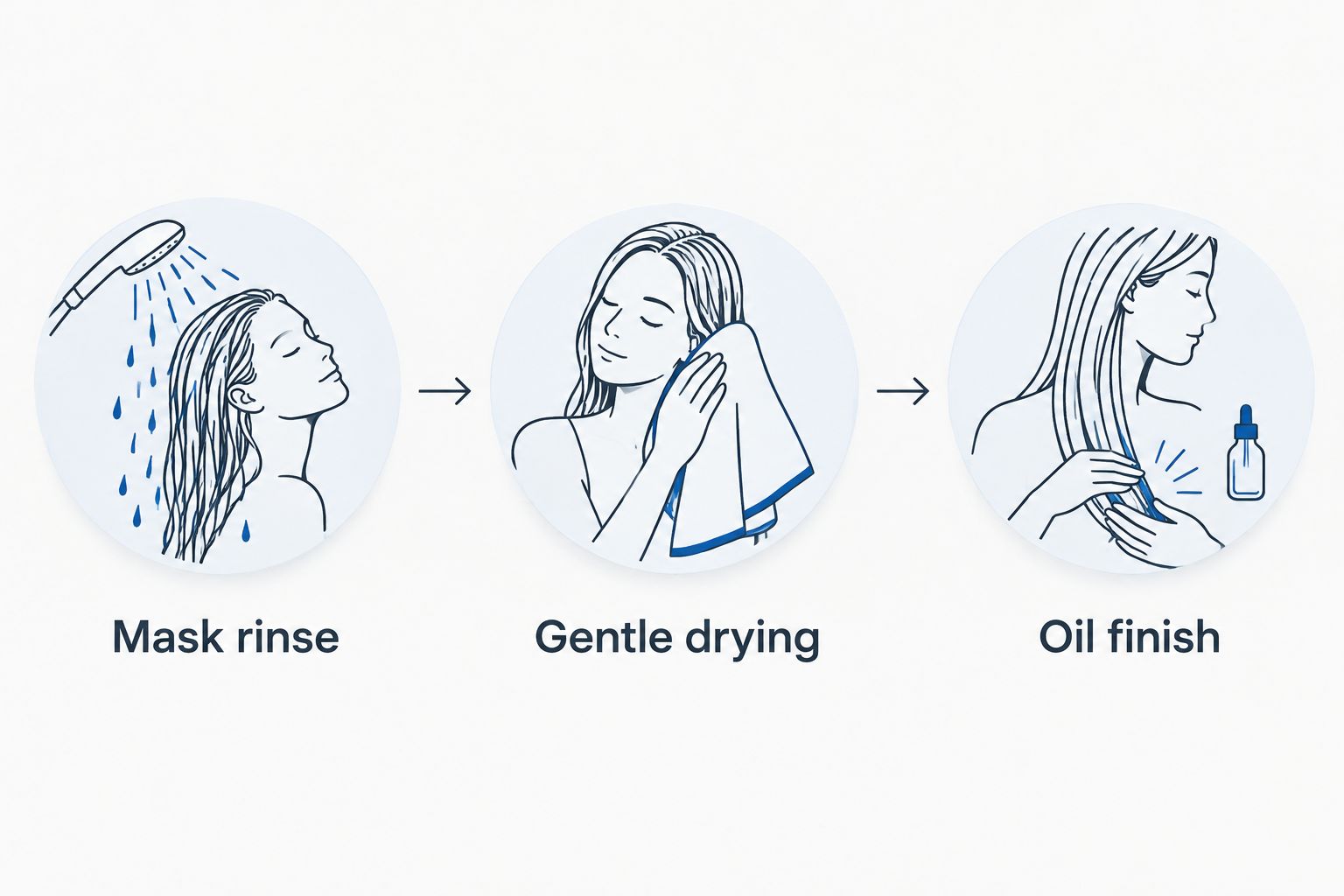
Oil finish
- Confirm leave-in suitability again. Use this stage only when the oil directions allow it. A wash-out-only formula belongs in the alternative workflow below.
- Follow the labelled amount. Spread the oil across your palms before touching the hair so it does not land in a concentrated patch.
- Apply where the lengths need it. Focus on the areas permitted by the label, commonly the lengths and ends. Do not automatically carry leftover oil onto the scalp.
- Distribute gently and reassess. Check whether the finish feels manageable or excessively coated before adding more. Stop when the intended application is complete.
- Finish styling without unnecessary pulling. If using heat, follow the styling tool and heat-protectant directions. Do not assume a hair oil provides heat protection unless its instructions explicitly say so.
Expected result: the oil is distributed without obvious greasy patches, and the hair remains manageable. If the mask alone already delivered that result, omit the oil finish next time.
For curly and coily hair, distribution and detangling need texture-specific handling rather than a universal dose. The curly and coily hair oil guide provides a related starting point.
Asian Treasures describes Hair Revival Oil as a traditional botanical blend. Use the actual bottle directions to decide where it fits; the product's botanical identity does not establish that every application method is suitable.
Alternative: oil before washing, then apply the mask
Best for: an oil whose directions require washing out. This route keeps the oil before cleansing rather than leaving it over freshly conditioned hair.
- Apply the oil to the areas specified on its label.
- Leave it on only as directed; do not invent an overnight treatment.
- Shampoo and rinse according to the oil and shampoo instructions.
- Apply the rinse-out mask according to its directions.
- Rinse, dry gently and assess the result before considering any separate leave-in product.
The benefit is a clear place for a wash-out oil. The drawback is an additional application stage, which is unnecessary if you prefer a simpler routine and your hair already feels manageable.
In 2026, choose between pre-wash and finishing use by reading directions—not by assuming longer contact or more layers deliver greater benefit. Neither route turns a cosmetic oil into a treatment for thinning hair.
What the evidence does—and does not—support
A study by Rele and Mohile, published in the Journal of Cosmetic Science in 2003, examined mineral, sunflower and coconut oils in relation to hair damage. It found reduced protein loss with coconut oil under the tested conditions. That is evidence about particular oils and hair-fibre outcomes, not proof that every botanical blend grows hair.
Ingredient evidence is not finished-product evidence. The study does not establish clinical effectiveness for Asian Treasures Hair Revival Oil, and it does not settle whether your particular mask-and-oil pairing will feel suitable.
The American Academy of Dermatology's guidance on hair shedding explains that shedding about 50–100 hairs per day is normal. That range is context, not a home diagnostic test: changes in density, a widening part or unusual shedding deserve assessment rather than progressively heavier oiling.
For your 2026 hair-care decisions, keep the outcome specific. Easier detangling, a different surface feel and less handling-related snapping are cosmetic goals; restoring lost density is a medical question.
Troubleshooting
Hair feels greasy after drying
Reduce the finishing layer rather than adding another product. Confirm that the mask was fully rinsed and that the oil permits leave-in use. At the next wash, assess the mask-only result before applying oil.
A heavy finish does not demonstrate that the hair needed a stronger treatment. It means the current combination or amount is not giving you the finish you want.
Hair still feels rough beneath an oily coating
Return to the conditioning and handling steps. Oil can change surface feel without resolving every source of roughness. Check mask directions, detangling technique and repeated heat or chemical exposure instead of continuing to layer oil.
The scalp itches, burns or becomes red
Stop the new product and follow its removal instructions. Do not interpret irritation as the oil working, and do not cover the reaction with another botanical mixture. Seek medical advice for persistent symptoms; urgent symptoms such as breathing difficulty need immediate care.
Flakes remain despite oiling
Do not assume flakes mean the scalp needs more oil. Dandruff and other scalp conditions need their own assessment and care. Keep the lengths-focused finishing routine separate from decisions about treating scalp symptoms.
Hair keeps shedding despite a softer finish
Separate softness from hair retention. Full-length shed hairs and short broken fragments are not interchangeable, although visual inspection alone cannot diagnose the cause. Arrange a dermatology assessment for sudden loss, bald patches, scalp pain or persistent thinning.
Customize your workflow
Change one part of the routine at a time: the finishing layer, the handling method or the product combination. That makes the next wash informative instead of leaving you unsure which change mattered.
For a practical 2026 routine, note whether your hair tangles less easily, feels coated or develops scalp discomfort. Do not use shine as a substitute for tracking a widening part or a change in density.
When buying in Pakistan, check the product's application directions and ingredient list rather than treating best hair growth oil as proof of regrowth. Choose cosmetic care for cosmetic goals, and seek an assessment when the concern is ongoing hair loss.
FAQ
Should I use hair oil after a hair mask?
Use hair oil after a rinse-out hair mask only if the oil permits leave-in application and your lengths need the extra finish. Rinse the mask first, gently remove excess water and follow the oil’s directions.
Should hair be wet or dry before applying finishing oil?
Follow the oil’s directions for damp or dry hair. Do not assume that a formula intended for dry hair works the same way on soaking-wet strands.
Can I leave my hair mask in and seal it with oil?
Do not leave a rinse-out mask in your hair and cover it with oil. A leave-in mask is a different product and needs its own application instructions.
Is oil before a mask better than oil afterward?
Neither order is universally better; the oil’s directions determine its place. A wash-out oil belongs before cleansing, while a leave-in-compatible oil can serve as a finishing layer after a rinsed mask.
Can Asian Treasures Hair Revival Oil go after my mask?
Use Asian Treasures Hair Revival Oil after your mask only if its current directions permit leave-in use. Its traditional botanical blend does not by itself establish the correct application method.
Will this routine stop shedding or regrow thinning hair?
A mask-and-oil routine is cosmetic care, not a proven treatment for medical hair loss. Reduced strand breakage does not mean the underlying cause of shedding has been treated.
Should I put finishing oil on a flaky scalp?
Do not automatically apply finishing oil to a flaky scalp. Persistent flaking, itching or redness needs separate assessment rather than simply adding more oil.
One last thing
Your best finishing step can be no finishing step. If rinsing the mask leaves your hair manageable, stop there. A useful ritual responds to your hair; it does not require another layer every wash.
Related guides
- Hair growth oil: separate cosmetic goals from hair-loss concerns
- Scalp oil for dandruff and flaking
- Hair oil for color-treated hair