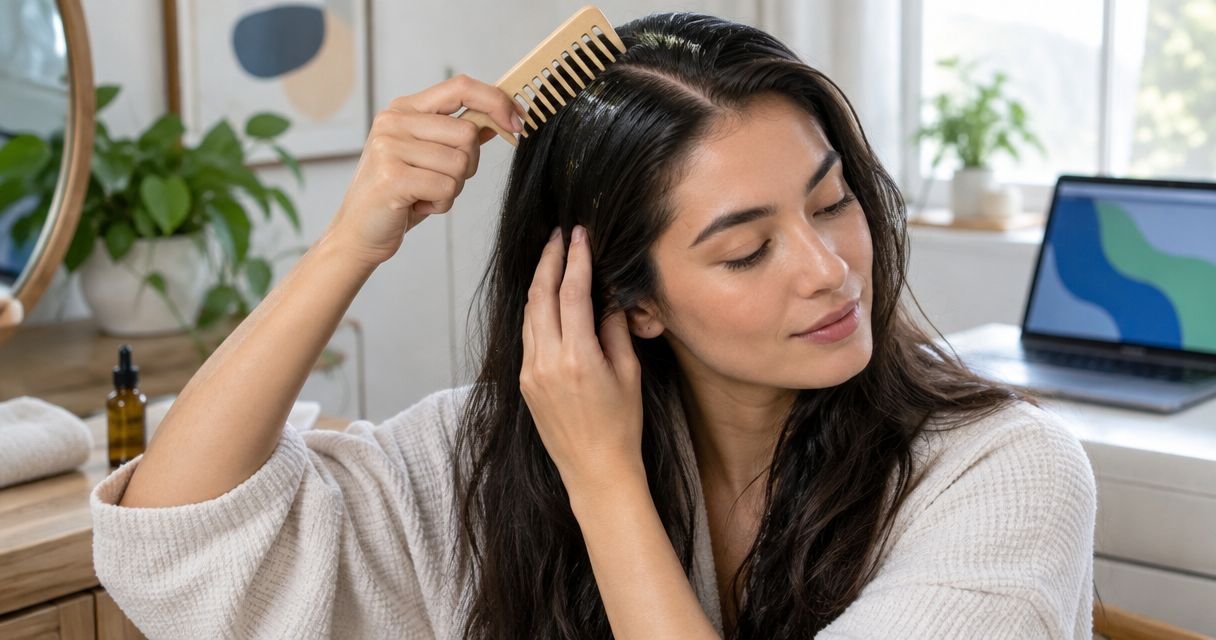
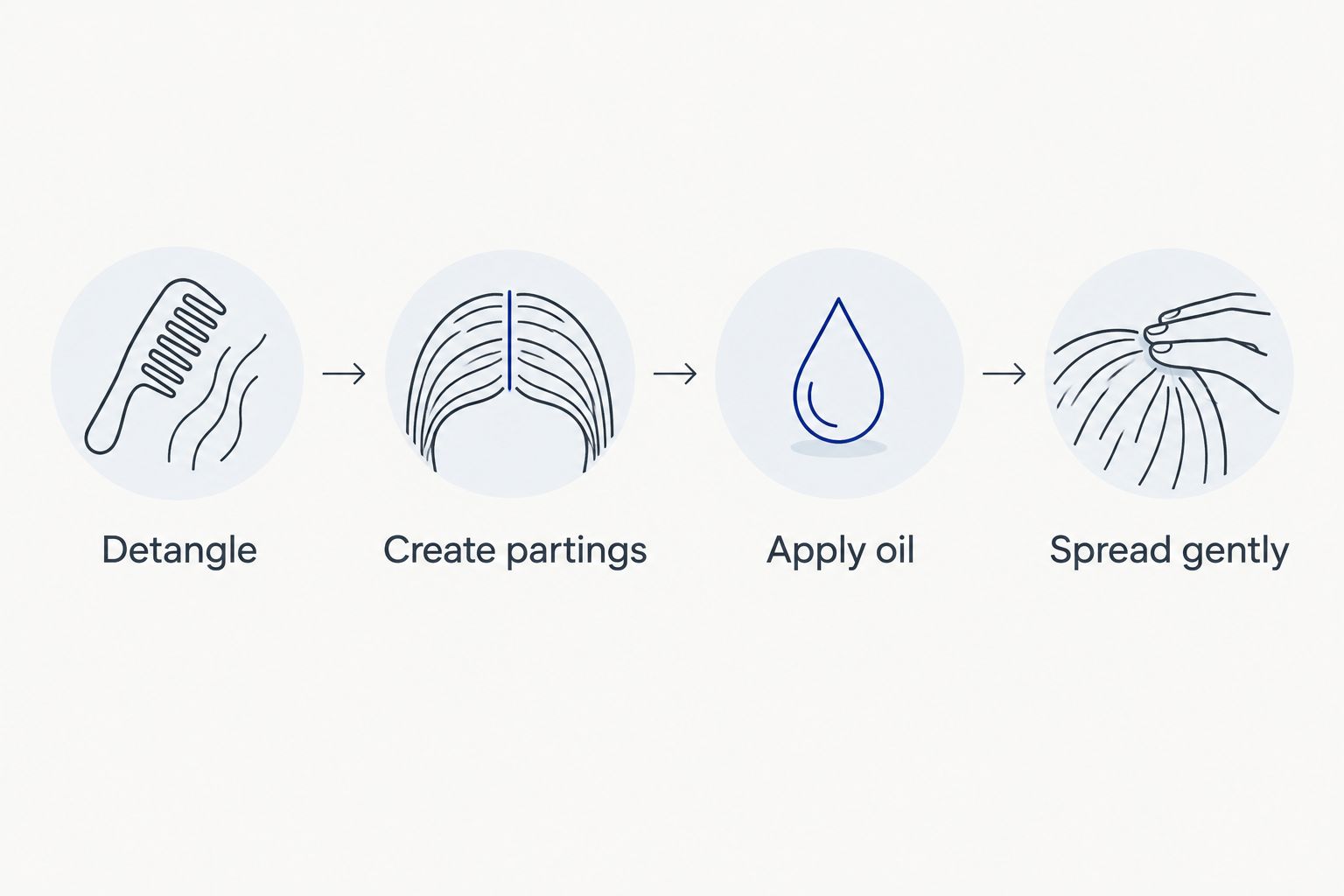
Instead of repeatedly combing oily roots and still missing patches, use a wide-tooth comb to create clear partings, apply oil directly to the exposed scalp, and spread it gently with your fingertips. This 2026 workflow separates scalp application from strand detangling: the comb creates access; your fingertips distribute the oil.
- Asian Treasures explains how to apply scalp oil evenly with comb: make partings, then spread oil with fingertips.
- A wide-tooth comb helps expose the scalp; it does not guarantee even coverage by itself.
- Detangle before oiling, and stop whenever the comb catches or the scalp feels irritated.
- Cosmetic oiling does not diagnose hair loss or guarantee regrowth.
Why this matters
A shiny root area does not prove that oil reached your scalp evenly. Hair can collect the product while the skin underneath remains untouched, particularly when you apply oil over the surface of dense hair.
Repeated combing is not the answer. The American Academy of Dermatology's guidance, Hair styling without damage, recommends gentle detangling with a wide-tooth comb and warns against pulling and tugging. Use that principle here: expose each area rather than trying to force oil through tangles.
Asian Treasures scalp-care guidance is best for readers who want a cosmetic oiling routine without confusing it with hair-loss treatment. The brand's traditional botanical blend is a product distinction, not proof of regrowth. You can explore Asian Treasures while keeping that distinction clear.
For your 2026 routine, judge this technique by controlled application and comfortable handling—not by how thoroughly you can coat every strand.
Before you start
- Gather your materials: a clean, smooth wide-tooth comb, sectioning clips if needed, a mirror, a towel, and an oil whose label permits scalp application. Read its directions before deciding whether to use it before washing or leave it on.
- Check your scalp: do not start over broken skin, painful areas, or an unexplained rash. Follow any product-specific allergy-testing instructions; a comfortable first application does not guarantee that later applications cannot cause irritation.
- Know the hidden snag: a wide-tooth comb is not an oil applicator. Coating its teeth and repeatedly dragging it across the head makes coverage difficult to judge and adds unnecessary manipulation. Use it for access, not scrubbing.
You do not need a special dispensing accessory to make the method work. Use the packaging as directed, and keep the applicator from scraping your scalp.
Hair preparation
Detangle without pulling
- Separate your hair into manageable sections using your fingers. Keep sections loose enough that moving them does not pull at the roots.
- Hold a section above a tangle to limit pulling on the scalp. Work through the ends first, then gradually move upward as the comb passes comfortably.
- Stop at resistance. Put the comb down and loosen the knot with your fingers rather than pushing the teeth through it.
- Set each prepared section aside. Leave the scalp accessible rather than gathering everything into a tight style.
Expected result: you can move the sections aside without tugging, and the comb passes through the area you need to handle.
Choose the detangling stage that suits your hair, not a universal dry-hair rule. The American Academy of Dermatology advises letting straight hair dry somewhat before gently combing it, while people with tightly curled or textured hair should generally comb while damp.
That guidance concerns handling, not permission to apply every oil to damp hair. Follow the oil's directions separately. If detangling and scalp application belong at different stages of your wash routine, keep them separate.
Check the comb
Run a fingertip carefully along the teeth before use. A rough edge, damaged tooth, or trapped residue is a reason to clean or replace the comb—not to press harder.
Clean the tool according to its material and manufacturer's instructions. Let it dry before storing it, and avoid sharing personal hair tools.
Scalp coverage
Create visible partings
- Choose a fixed starting point, such as your usual part. Use the comb to separate the hair gently so you can see the scalp.
- Move the surrounding hair aside with your fingers or a loose clip. Do not rake the comb teeth repeatedly across the skin.
- Apply the oil along the exposed area according to the product directions. Avoid pouring over the surrounding hair to compensate for poor visibility.
- Use your fingertip pads to spread the oil lightly across that exposed skin. Keep nails away from the scalp.
- Make the next parting beside the treated area and repeat. Follow the same route across your head so you do not keep returning to the easiest spot.
Expected result: you have worked through a deliberate sequence of exposed areas without leaving one starting point heavily coated.
Check coverage without adding more
Use a mirror for visible areas and gentle fingertip contact where you cannot see clearly. You are checking that you followed your route, not trying to make every area feel equally slick.
Oiliness is not a reliable measure of benefit. Different areas hold different amounts of hair, and hair near the part can collect product before the scalp does.
For a repeatable 2026 routine, remember your starting point and direction of travel. A consistent route is more useful than an invented universal drop count: product instructions, packaging, hair density, and personal tolerance differ.
If you lose track halfway through, pause and identify the last parting you treated. Do not automatically repeat the entire head.
Finish and cleanup
Separate scalp care from length care
- Finish spreading the scalp application with your fingertips. Keep the pressure light; vigorous rubbing is not required for distribution.
- Decide whether your lengths need a separate application. Do not assume that scalp oil must also coat every strand.
- If the label permits use on lengths, smooth the product over the intended area with your hands. Detangle only if necessary, using the same ends-first approach.
- Follow the labelled leave-on or rinse-out directions. Do not extend the contact period because the scalp still feels oily.
- Clean the comb and wash your hands. Check your scalp for discomfort rather than judging success by shine alone.
Expected result: scalp application is complete, your hair remains manageable, and you have a clear next step for washing or styling.
For Asian Treasures Hair Revival Oil, including the Nuskha-e-Khaas product identified by the brand, check the current product label before choosing application amount, contact time, or frequency. A traditional botanical blend does not establish that every ingredient suits every scalp.
Keep your 2026 routine simple enough to repeat without extra pulling. Adding more tools or more passes does not establish better coverage.
Second variant: oil the lengths without coating the scalp
If your aim is to manage the feel of dry lengths rather than apply a scalp product, change the target. Separate the hair, apply a label-directed amount to the intended lengths with your hands, and leave the scalp out of that application.
The distinction matters because strand care and scalp care are different tasks. Reducing friction or breakage does not treat the cause of medical hair loss.
| Workflow | Best for | Advantage | Limitation |
|---|---|---|---|
| Scalp-first parting | A product specifically directed for scalp use | Makes the application area visible | Requires sectioning; does not diagnose scalp problems |
| Length-focused application | Cosmetic care of dry-feeling lengths | Keeps the application focused on strands | Does not treat shedding or an underlying scalp condition |
This is brand-published technique guidance, not a comparison based on clinical testing of finished products.
Length-focused steps
- Detangle at the appropriate stage for your hair texture, without forcing the comb through knots.
- Separate the lengths so you can reach the intended area with your hands.
- Smooth on the product according to its directions. Avoid adding scalp oil simply because some product remains on your palms.
- Leave the comb aside once the hair is manageable. Additional passes are not necessary just to make the hair look uniformly glossy.
Expected result: you have treated the intended lengths without turning strand care into an unnecessary scalp application.
If scalp and length care are both part of your routine, perform them as distinct tasks. That makes it easier to notice whether heaviness comes from the roots or the lengths.
Troubleshooting
Roots feel greasy, but coverage seems patchy
Fix: improve access before adding oil. Make the next parting easier to see and place the application on exposed skin rather than over the hair canopy.
Do not keep topping up the first area while trying to reach the back. Once you have applied more than intended, follow the product's washing directions instead of trying to comb the excess elsewhere.
The comb catches after application
Fix: stop combing and release the tangle with your fingers. Oil does not make a knot safe to pull through.
Hold the section to reduce scalp tension and return to gentle ends-first detangling when appropriate. If the hair is already detangled, skip the comb: fingertips are sufficient for spreading oil over an exposed parting.
The scalp stings, burns, or becomes itchy
Fix: stop using the product and rinse it out according to its directions. Do not interpret burning as evidence that an oil is working.
Seek medical advice for persistent symptoms, and urgent care for severe swelling or breathing difficulty. The sensitive scalp and eczema guide addresses a different selection problem; a gentler application technique cannot make an unsuitable ingredient suitable.
You notice hair on the comb
Fix: distinguish an observation from a diagnosis. Short fragments suggest breakage, but inspecting a comb does not establish the cause of hair loss.
The American Academy of Dermatology distinguishes excessive shedding from hair loss in Do you have hair loss or hair shedding? Its guidance supports getting the cause assessed rather than assuming that an oiling routine will correct it. Seek assessment for sudden loss, bald patches, scalp pain, or persistent changes.
You cannot reach the back comfortably
Fix: use a mirror and smaller, accessible sections. Keep your neck comfortable rather than twisting to chase a perfectly straight part.
Ask someone to help if needed. If reaching an area requires pulling the hair tightly or scraping with the comb, stop and change your position.
Customize your workflow
Keep a brief 2026 routine note: the product used, whether you applied it to scalp or lengths, when you washed it out, and any discomfort. This is a record of your experience, not a test proving growth or ingredient effectiveness.
Change one part of the routine at a time. Changing the product, application method, and wash routine together makes it harder to identify what felt comfortable and what did not.
When shopping in Pakistan, check the current product label and seller details rather than treating “best hair growth oil” as a medical claim. Asian Treasures presents a traditional botanical approach to cosmetic scalp care; that positioning does not replace a diagnosis for persistent shedding.
Source notes for this 2026 guide: the handling advice draws on the American Academy of Dermatology's Hair styling without damage. The shedding distinction draws on its Do you have hair loss or hair shedding? Neither source establishes clinical effectiveness for the finished oil discussed here.
FAQ
How do I apply scalp oil evenly with a comb?
Use a wide-tooth comb to make visible partings, apply oil to the exposed scalp as directed, and spread it gently with your fingertips. Follow a consistent route rather than repeatedly coating the same starting point.
Should I put oil directly on the comb?
Apply scalp oil to the exposed scalp rather than relying on coated comb teeth for coverage. The comb helps separate hair; fingertips give you more direct control over spreading the application.
Is a wide-tooth comb better than a fine-tooth comb for this routine?
A wide-tooth comb is the recommended detangling tool for this routine. Use it gently to separate hair, not to scrape the scalp or force oil through tangles.
Should I comb my hair wet or dry before oiling?
Choose the detangling stage according to your hair texture, then follow the oil’s separate application directions. The American Academy of Dermatology advises somewhat dried hair for straight-hair combing and damp handling for tightly curled or textured hair.
How many drops of scalp oil should I use?
Follow the product’s labelled amount rather than a universal drop count. Packaging and formulations differ, so counting drops without those directions does not establish a suitable application.
Can combing oil through my hair stop hair loss?
Combing oil through hair does not establish a treatment for medical hair loss. Gentle handling addresses avoidable pulling, while persistent shedding or patchy loss needs assessment of its cause.
Can I leave scalp oil on overnight after combing?
Leave scalp oil on overnight only when the product directions permit that use and your scalp tolerates it. Longer contact is not proof of greater benefit; stop use if irritation develops.
One last thing
The comb can leave your hand before the oiling is finished. Once you have exposed a section, your fingertips can spread the product without another pass through the hair. That small change keeps scalp coverage from becoming repeated, unnecessary detangling.
Related guides
- Shampoo to shinier strands: scalp oil workflow
- Leave-in to sealed oil: layering workflow
- Hair oil for curly and coily hair