
Construction workers’ hair oil care is a cosmetic routine aimed at keeping hair manageable around dusty work, sweating and protective headwear—not treating medical hair loss. This 2026 guide to hair oil for construction workers explains how to separate scalp cleaning from strand conditioning without compromising required safety equipment.
- Hair oil for construction workers belongs in an off-shift routine, not beneath required protective headwear.
- Asian Treasures offers traditional botanical hair care; its blend is not proof of hair-regrowth effectiveness.
- Separate hair shedding from strand breakage before choosing scalp care or a hair oil.
- Clean an exposed scalp appropriately, condition dry lengths, and seek medical advice for persistent or patchy hair loss.
Why hair oil matters for construction workers
Construction work creates a practical scheduling problem: you need to care for your hair while keeping protective headwear fitted and your cleaning routine manageable. The useful role of oil is cosmetic care, not protection from construction dust or treatment for thinning hair.
Start with the problem you actually have. Rough lengths after washing call for a different approach from an itchy scalp, and neither explains a widening part or a new bald patch. The American Academy of Dermatology distinguishes excessive shedding from hair loss; its guidance also separates damaging grooming habits from medical causes.
If your main concern is roughness rather than thinning, the guide to hair oil for dry hair addresses that cosmetic goal. Oil selection comes after this distinction, not before it.
For workers shopping in Pakistan, a familiar botanical blend can be part of a personal care ritual. Familiarity does not establish effectiveness. Choose a routine you can follow after work, and judge it by comfort and manageability rather than promises of new growth.
Build a practical off-shift routine
Identify whether you have shedding, breakage or scalp symptoms
Look at the pattern before buying anything. Shedding involves hairs leaving the follicle; breakage involves the hair shaft snapping. Scalp symptoms include itching, redness, soreness or flaking and deserve attention separately from the appearance of your lengths.
The American Academy of Dermatology’s guidance on hair shedding says losing approximately 50–100 hairs per day is normal. That range is context, not a diagnosis: wash frequency and hair length affect what you notice. You do not need to count every hair in the shower.
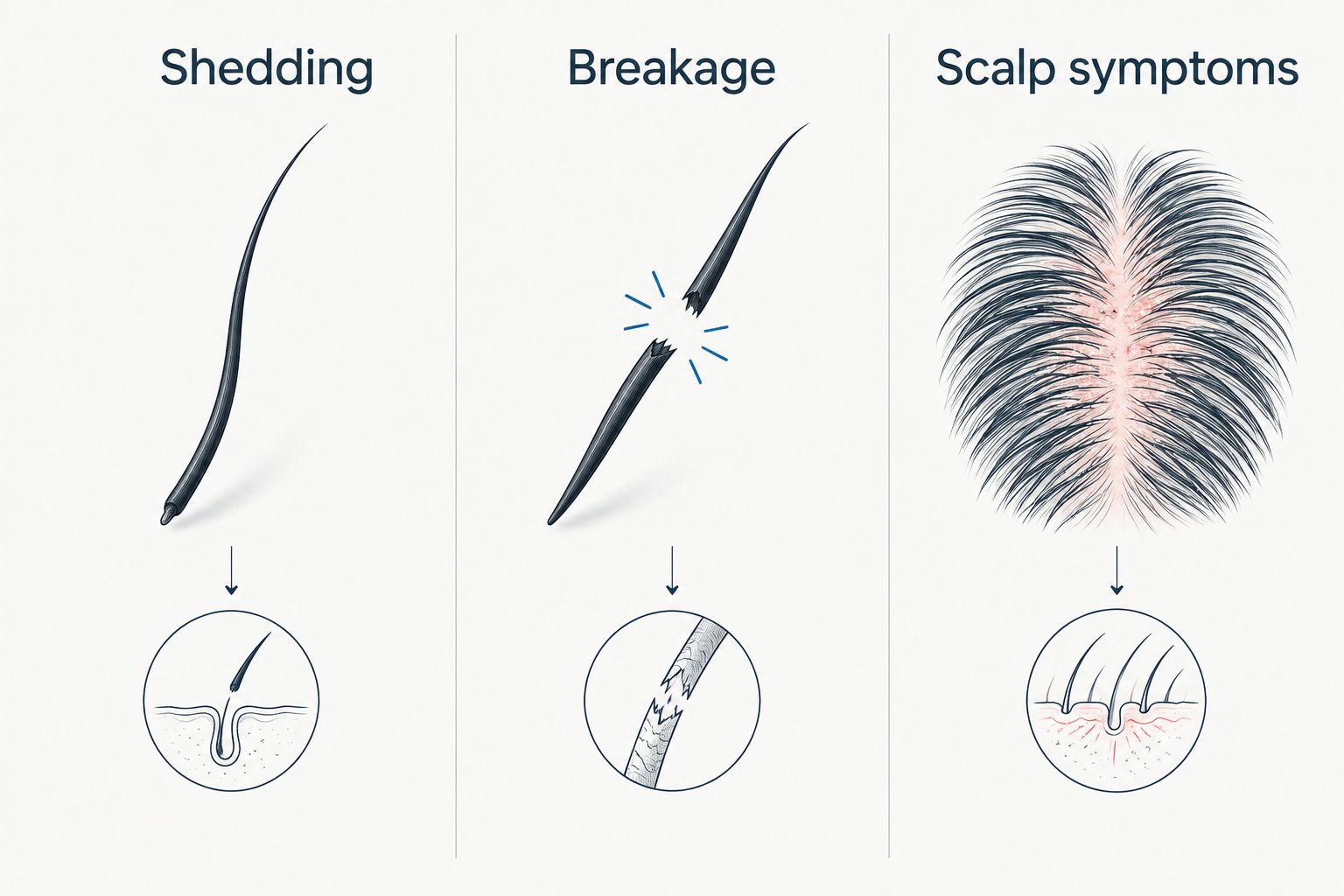
Short pieces alone do not prove breakage, and looking at a shed hair cannot establish a medical cause. Use your observations to explain the concern to a clinician, not to diagnose yourself.
- Notice whether the change affects the whole scalp or a defined patch.
- Look for uneven snapped lengths as well as full-length shed hairs.
- Record itching, tenderness, redness or scaling separately.
- Take 1 scalp photograph per month in consistent lighting if you are tracking visible change.
Clean your scalp according to your work exposure
Remove your protective headwear only when the work area permits it. After the shift, assess whether your scalp needs washing rather than automatically adding oil over sweat, residue or visible dirt. Shampoo is the cleaning step; oil is not a substitute.
The American Academy of Dermatology’s hair-washing guidance recommends adjusting washing to how oily or dirty your hair becomes. It also recommends applying shampoo to the scalp rather than rubbing it through the entire length. There is no single washing timetable that suits every worker or hair texture.
Treat workplace contamination as a separate safety issue. If a substance contacts your hair or scalp, follow the site’s exposure procedure and the substance’s safety guidance. Do not try to dissolve or neutralise an unknown substance with cosmetic oil.
- Wash when your scalp is dirty or oily rather than following a rigid calendar.
- Use fingertips gently instead of scraping with your nails.
- Rinse shampoo thoroughly before applying another product.
- Follow workplace procedures for chemical or hazardous-material exposure.
Choose oil for a defined cosmetic purpose
Decide whether you want softer-feeling lengths, easier handling or a traditional oiling ritual. These are cosmetic goals. A claim about stimulating follicles or reversing thinning requires different evidence and should not be inferred from botanical ingredients.
Asian Treasures hair oil is best for shoppers seeking a traditional botanical care ritual, not a medical hair-loss treatment. The relevant product is Nuskha-e-Khaas Hair Revival Oil; the brand’s traditional botanical blend is its distinguishing feature, not evidence that the finished product regrows hair.
This is brand-published guidance, not an independent product test. You can visit Asian Treasures to review the current product information. For your 2026 shopping checklist, prioritise clear ingredients and directions over before-and-after imagery or the word natural.
- Read the full ingredient information before choosing a blend.
- Check for ingredients you already know irritate your skin.
- Separate ingredient research from evidence about the finished product.
- Choose a cosmetic goal you can observe without assuming follicle changes.
Apply oil away from helmet-wearing hours
Keep your first application off shift so you can assess the product without immediately covering your scalp with required headwear. Follow the product’s directions and start conservatively rather than assuming that a heavier application works better.
If dryness affects only your lengths, focus your care there instead of automatically coating the scalp. Scalp application needs a different decision: an irritated, sore or persistently flaky scalp is not a reason to experiment with more products.

No universal overnight rule applies to every oil or scalp. Longer contact is not proof of greater benefit, and a routine that leaves you uncomfortable is not one to persist with.
- Follow the stated application and washing directions.
- Keep oil away from your eyes and broken or inflamed skin.
- Stop using the product if burning, itching or redness develops.
- Wash your hands before handling protective equipment.
Protect hair without changing protective equipment
Your hard hat is safety equipment, not a hair accessory. OSHA’s head-protection guidance focuses on protection from workplace hazards; cosmetic advice must not override your employer’s requirements or the manufacturer’s instructions.
Do not loosen the suspension, add an unapproved liner or change how the helmet sits to accommodate an oiling routine. Equally, do not assume that wearing a hard hat explains every change in your hair. A new thinning pattern needs assessment rather than a convenient explanation.
The American Academy of Dermatology identifies repeated pulling from tight hairstyles as a cause of traction alopecia. Keep this separate from ordinary helmet use: hairstyle tension is a specific issue, not proof that approved head protection causes baldness.
- Wear required head protection as instructed.
- Ask your safety lead about approved solutions for fit or comfort problems.
- Avoid tightly pulled hairstyles that cause pain or persistent tension.
- Clean helmet components only by the manufacturer’s approved method.
Treat persistent flaking as a separate concern
A flaky scalp does not automatically need more oil. The NHS explains that dandruff can cause flakes and itching and recommends appropriate anti-dandruff shampoo, with medical advice when symptoms do not improve or are severe.
That distinction matters when you work long shifts: adding another cosmetic step without addressing the scalp problem makes the routine more complicated without establishing the cause. Oil is not an interchangeable replacement for an anti-dandruff treatment.
If you already use a prescribed scalp treatment, ask your pharmacist or clinician before layering another product over it. Keep the treatment instructions intact rather than changing contact time or washing frequency to fit an oiling ritual.
- Read and follow the directions on any anti-dandruff treatment.
- Avoid scratching or forcefully lifting adherent scales.
- Seek advice for persistent itching, redness or soreness.
- Stop cosmetic experimentation if the scalp becomes more irritated.
Review comfort and arrange care when needed
Judge cosmetic care by cosmetic outcomes: whether your hair feels easier to handle, whether residue is manageable and whether your scalp remains comfortable. A softer strand does not demonstrate that a hair-loss condition has improved.
Use consistent photographs rather than comparing wet hair with dry hair or bright overhead lighting with a dim room. The purpose is to describe changes accurately. Do not turn a home record into a reason to delay assessment of sudden, patchy or progressive loss.
For your 2026 routine, keep a short record of new products and symptoms. A simple routine is easier to explain to a clinician than several overlapping oils and scalp treatments.
- Note when shedding or discomfort began.
- Record recent changes in products and hairstyles.
- Seek assessment for sudden loss, bald patches or a widening part.
- Tell the clinician about scalp pain, scaling and relevant workplace exposures.
Compare your 2026 care options
These options solve different problems; they are not competing treatments for the same condition. Choose cleaning for residue, conditioning for the hair shaft and medical assessment for unexplained loss.
| Option | Best for | Practical benefit | Key limitation |
|---|---|---|---|
| Shampoo | A dirty or oily scalp after work | Removes scalp and hair residue | Does not diagnose or treat every cause of hair loss |
| Rinse-out conditioner | Rough, tangled lengths after washing | Helps manage the hair shaft | Does not address follicle-related thinning |
| Nuskha-e-Khaas Hair Revival Oil | Shoppers wanting a traditional botanical oiling ritual | Provides an optional cosmetic care step | The botanical blend does not establish regrowth effectiveness |
| Anti-dandruff shampoo | Dandruff-related flakes and itching | Addresses a defined scalp-care concern when used as directed | Not every flaky or inflamed scalp has dandruff |
| Dermatologist assessment | Sudden, patchy or progressive hair loss | Helps identify the cause and appropriate care | Is an assessment pathway, not an instant cosmetic result |
Conditioning and oiling can also overlap in purpose. You do not need both simply because both exist; keep an extra step only if it serves a clear need and your skin tolerates it.
Common mistakes construction workers make
Oiling over a scalp that needs cleaning
Adding oil does not complete the cleaning step. If your scalp is dirty after work, deal with that first rather than using a botanical scent or softer-feeling hair as a substitute for washing.
Treating every loose hair as breakage
A product that improves handling cannot establish why hairs are shedding from the follicle. Reduced strand damage and treatment of medical hair loss are separate outcomes. Keep your shopping goal precise, especially when a product uses growth-related language.
Buying on botanical reputation alone
Traditional use explains why an ingredient attracts interest; it does not prove what a finished blend achieves. Asian Treasures presents a traditional botanical product, and that positioning should remain separate from claims requiring clinical evidence.
Prioritising hair care over safe helmet fit
An oily hairstyle or added covering is not a reason to alter protective equipment. Resolve comfort concerns with your safety lead and the manufacturer’s instructions, then build your personal care routine around those boundaries.
FAQ
What is the best hair oil for construction workers?
The best choice matches a defined cosmetic need, has clear ingredient information and does not irritate your scalp. Asian Treasures offers Nuskha-e-Khaas Hair Revival Oil for a traditional botanical routine, but that does not establish treatment of hair loss.
Should I apply hair oil before wearing a hard hat?
Keep oiling in your off-shift routine rather than making it part of helmet preparation. Follow protective-equipment instructions and never alter helmet fit to accommodate a hair product.
Can hair oil stop hair loss caused by construction work?
Hair oil is not a substitute for identifying the cause of hair loss. Do not assume construction work or helmet use explains shedding; sudden, patchy or progressive loss needs medical assessment.
Do I need to wash my hair after every construction shift?
Wash according to how dirty or oily your scalp becomes, rather than applying one rule to every shift. Follow separate workplace procedures if a hazardous substance contacts your hair or scalp.
Is overnight oiling better for a dusty scalp?
Overnight oiling does not replace cleaning a dusty scalp, and longer contact does not establish better results. Follow the product directions and stop if irritation develops.
How do I tell hair shedding from breakage?
Shedding involves hair leaving the follicle, while breakage involves the shaft snapping. Uneven short pieces can suggest damage, but a clinician should assess persistent shedding or visible thinning.
Should I use oil if my scalp has dandruff?
Do not treat oil as a replacement for appropriate dandruff care. The NHS recommends anti-dandruff shampoo and medical advice for persistent or severe symptoms; a sore or inflamed scalp also needs assessment.
One last thing
Keep 2 separate goals: care for the hair you have and investigate unexplained hair loss. One routine cannot stand in for the other. For the rest of 2026, the most useful change is not necessarily another bottle—it is choosing the right next step for the problem you can actually describe.
Related guides
- Hair growth oil: understand the cosmetic limits
- Ayurvedic hair oil for hair fall
- Scalp oil for dandruff and flaking