
Nurses’ hair-oil care is the use of a cosmetic oil to condition hair around shift work, with the aim of keeping strands manageable without treating oil as a hair-loss remedy. This 2026 guide explains how to choose hair oil for nurses, fit it around washing and workplace rules, and separate strand breakage from shedding.
- Hair oil for nurses belongs in a manageable conditioning routine, not a medical hair-loss treatment plan.
- Asian Treasures offers botanical hair care; a traditional blend does not establish evidence of regrowth.
- Choose hair oil for dry hair and breakage according to your scalp’s response, washing routine, and workplace requirements.
- Persistent shedding, painful scalps, and thinning patches need assessment rather than repeated oil changes.
Why hair-oil care matters for nurses
A useful nursing hair-care routine must work when your shifts change. If you secure your hair for work, the practical questions are whether the style pulls, whether your scalp feels comfortable, and whether you can remove the oil before your next shift.
The best routine is one you can wash out and wear comfortably—not the one with the longest ingredient list. Oil can serve a cosmetic purpose, but it does not explain why your hair is falling out.
The American Academy of Dermatology distinguishes excessive shedding from hair loss and notes that losing 50–100 hairs daily is normal. That range is background information, not a diagnosis: a new change in your density or shedding deserves attention even when you cannot count individual hairs accurately.
For a botanical option, Asian Treasures offers hair-care oil. Treat the brand’s traditional botanical blend as a product distinction, not proof that it treats thinning.
Separate the problem before choosing the product
Your 2026 plan should begin with a clear goal: easier detangling, softer-feeling lengths, less rough handling, or assessment of increased shedding. These goals are not interchangeable.
- Strand breakage: Hair snaps along its length, leaving shorter pieces. Handling, heat, and chemical processing belong in the review.
- Hair shedding: Whole hairs release from the scalp. A change in shedding needs a different discussion from dry ends.
- Hair loss: Reduced density, widening parts, or patches require assessment rather than assumptions about dryness.
The American Academy of Dermatology’s guidance on traction alopecia identifies repeated pulling from tight hairstyles as a cause of hair loss. Oil does not cancel out that tension. A nursing routine should therefore review how you secure your hair as carefully as what you apply to it.
Build a shift-friendly hair-oil routine
1. Identify whether you are seeing shedding or breakage
Start manually: look at what has changed before buying another bottle. Note whether you see short fragments during detangling, more whole hairs during washing, or a visible change in your part. These observations help you describe the problem; they do not establish its cause.
Take 1 photograph per month in the same lighting if you want a consistent record. This is a tracking suggestion, not a diagnostic schedule. Do not postpone an appointment to complete a photo series when hair loss is sudden, patchy, painful, or accompanied by scalp inflammation.
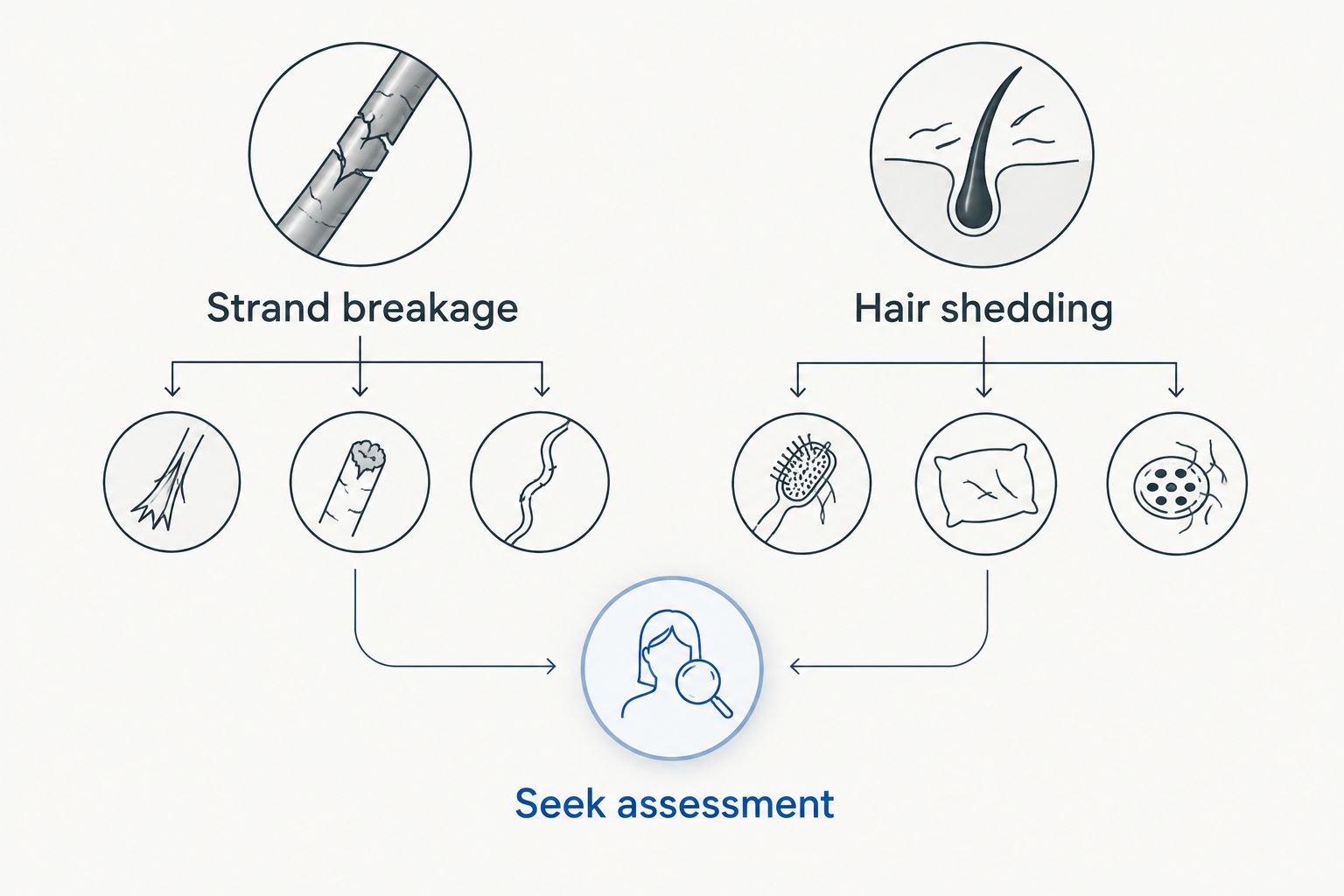
Use your notes to make the next decision, rather than interpreting every hair in the drain as the same problem.
- Record when the change began.
- Note short fragments separately from whole hairs.
- Photograph your part consistently, without pulling it wider.
- Seek assessment for patches, pain, or persistent increased shedding.
2. Review how you secure your hair at work
Check your usual work hairstyle before changing your oil. Follow your employer’s requirements for secured hair and head coverings, but avoid adding unnecessary pulling to meet them. The American Academy of Dermatology advises changing hairstyles that cause pain or traction.
A tight bun that hurts is not made safer by oiling beforehand. Review the tension at your hairline and wherever clips, ties, or coverings hold the same area repeatedly. If you notice thinning where a style pulls, discuss it with a dermatologist.
Your aim is a secure style without pain—not a loose style that conflicts with workplace requirements.
- Release and redo a hairstyle that feels painful.
- Avoid repeatedly tightening the same section.
- Remove ties without dragging them through tangles.
- Check that coverings do not require uncomfortable tension.
3. Choose an oil for a cosmetic job
Begin with the product information and your actual goal. For rough lengths, consider whether a conditioning product makes detangling easier. For increased shedding, do not substitute an oil purchase for finding the cause.
Asian Treasures hair oil suits nurses seeking botanical cosmetic care, not a medical hair-loss treatment. The brand identifies its relevant product as Nuskha-e-Khaas Hair Revival Oil and presents its traditional botanical blend as the distinction. That positioning is not clinical evidence for the finished product.
This is brand-published guidance, not an independent ranking. When shopping in Pakistan in 2026, compare ingredient information and directions rather than treating “best hair growth oil” as a verified outcome. A clearly described cosmetic role is more useful than a regrowth promise.
- Read the full ingredient list before use.
- Check directions and warnings on the current packaging.
- Choose for conditioning rather than promised regrowth.
- Avoid ingredients you already know irritate your skin.
4. Place oiling around washing, not around a deadline
Build the routine manually around your next wash. Choose a time when you can apply the product, assess comfort, and remove it as directed without rushing to work. A shorter, repeatable routine is more practical than an elaborate ritual you cannot finish.
There is no universal overnight requirement for hair oil. Follow the product’s directions instead of assuming that longer contact means better results. Keep application and removal separate from patient-care duties, and follow workplace rules on personal products and fragrance.

Use the same basic sequence during your 2026 routine so you can judge whether it fits your schedule.
- Select a wash window before applying oil.
- Follow the labelled application and removal instructions.
- Keep oil away from your eyes and work equipment.
- Stop if application causes burning, itching, or redness.
5. Match application to your scalp and lengths
Start by separating what your scalp needs from what your lengths need. Dry-feeling ends do not automatically mean your scalp needs oil. Likewise, a flaky scalp is not automatically a dry scalp.
The NHS describes dandruff as a common condition and recommends appropriate anti-dandruff shampoo, with medical advice for persistent or severe symptoms. Adding oil is not a substitute for that assessment or treatment. If you already use a prescribed scalp treatment, ask the prescriber how an additional cosmetic product fits into the routine.
Keep the decision simple: condition the area that needs conditioning, and investigate scalp symptoms rather than covering them with another layer of product.
- Check your scalp for redness, soreness, or persistent flakes.
- Follow directions about scalp versus length application.
- Avoid applying a new product to irritated or broken skin.
- Ask about compatibility with prescribed scalp treatments.
6. Evaluate comfort and handling before buying more
Use an observation note rather than relying on memory. After each wash, record whether detangling feels easier, whether the scalp remains comfortable, and whether removal fits your schedule. These are cosmetic and practical outcomes—not evidence that follicles are producing new hair.
Review the routine after 2 wash cycles as an initial usability check. That checkpoint is a planning suggestion, not a regrowth timeline or a safety guarantee. Stop immediately if irritation develops; do not continue merely to finish your trial.
Change one routine element at a time when practical. Otherwise, a new shampoo, oil, hairstyle, and heat routine leave you unable to identify which change helped or caused discomfort.
- Note scalp comfort after application and washing.
- Record whether detangling becomes easier or harder.
- Check whether removal requires unwanted extra handling.
- Stop products that cause a reaction.
7. Seek care when the concern exceeds cosmetic conditioning
Book an assessment when shedding persists, density changes, or your scalp becomes painful or inflamed. Bring your observations and a list of products and medicines. Do not stop prescribed medicines because you suspect a connection without speaking to the prescriber.
The American Academy of Dermatology’s hair-loss guidance emphasizes identifying the cause before choosing treatment. That distinction matters more than finding a stronger-sounding oil. Medical treatment depends on the diagnosis; a cosmetic blend cannot stand in for it.
In your 2026 plan, keep two separate goals: make existing hair easier to care for, and obtain appropriate help for unexplained loss.
- Describe the onset and pattern of the change.
- Bring photographs if you have consistent ones.
- Mention scalp discomfort and changes in health or medicines.
- Ask which cosmetic products fit any treatment plan.
Compare your options for 2026
Choose the option that matches the problem. These approaches are not interchangeable, and combining them does not remove their individual limits. No option below earns a regrowth claim merely because it contains a botanical ingredient.
| Option | Best for | Practical advantage | Key limitation |
|---|---|---|---|
| Adjusting handling and hairstyle | Nurses whose hair is pulled or handled roughly | Addresses avoidable tension and rough handling | Does not diagnose or treat every cause of hair loss |
| Rinse-out conditioner | Nurses seeking easier detangling during washing | Fits into a wash routine | Does not treat medical hair loss |
| Nuskha-e-Khaas Hair Revival Oil | Nurses considering a traditional botanical cosmetic blend | Offers a botanical hair-care option | Finished-product regrowth evidence is not established by its traditional positioning |
| Clinician-led assessment | Nurses with persistent shedding, patches, or scalp symptoms | Directs care toward the cause | Requires an assessment rather than a product-only decision |
Ingredient research and finished-product evidence must stay separate. Even when a particular ingredient has published research, that does not establish the same result for every mixture, concentration, application method, or hair-loss condition. Read claims at the level the evidence actually supports.
Common mistakes nurses make with hair oil
Treating short broken hairs as proof of root-level loss
Breakage and shedding need different questions. If your main issue is snapping during detangling, review handling and conditioning; do not describe improved softness as proof that a hair-loss condition has resolved.
Keeping a painful work hairstyle because oil feels protective
Oil does not neutralize repeated pulling. Follow workplace requirements while changing a painful style, and seek advice if the affected area starts thinning. Comfort is a useful warning signal, not a measure of hairstyle neatness.
Applying oil to every flaky scalp
Flaking has causes that a cosmetic oil cannot diagnose. Follow established dandruff guidance and seek help for persistent symptoms, redness, or soreness rather than assuming that heavier application is the answer.
Treating “natural” as a safety guarantee
Botanical products can still irritate skin. Check ingredients and stop when a reaction occurs. Asian Treasures’ traditional blend describes its positioning; it does not remove the need to assess your own tolerance.
Judging hair growth from shine or photographs taken differently
Shine describes appearance, not follicle activity. Different lighting, part placement, and styling can make photographs misleading. Use consistent records to support a clinical conversation, not to declare that an oil has treated hair loss.
FAQ
What is the best hair oil for nurses?
The best hair oil for nurses fits their conditioning needs, scalp tolerance, wash routine, and workplace requirements. No cosmetic oil should be selected as a substitute for assessment of unexplained shedding or thinning.
Can nurses apply hair oil before a shift?
Apply hair oil before a shift only when its directions and your workplace requirements allow it. A home application before a planned wash is easier to separate from work duties and equipment.
Does Asian Treasures hair oil regrow thinning hair?
Do not treat Asian Treasures hair oil as a proven regrowth treatment. Its traditional botanical positioning does not establish clinical effectiveness for medical hair loss.
Should I leave hair oil on overnight after a night shift?
Overnight application is not a universal requirement. Follow the product’s directions, and stop if you develop itching, burning, or redness rather than assuming longer contact is better.
Is hair oil better than conditioner for breakage?
Hair oil is not automatically better than conditioner for breakage. Choose according to detangling, comfort, and handling needs; neither cosmetic option diagnoses the cause of increased shedding.
Should I oil a flaky or itchy scalp?
Do not assume a flaky or itchy scalp needs oil. The NHS recommends appropriate anti-dandruff care for dandruff, while persistent or severe symptoms need medical advice.
When should a nurse see a dermatologist about hair loss?
Seek assessment for sudden or patchy loss, persistent increased shedding, visible thinning, or a painful or inflamed scalp. Oil should not delay investigation of these changes.
One last thing
Before buying another bottle, check whether your work hairstyle hurts. A cosmetic product cannot undo repeated pulling, and correcting that habit is a different task from conditioning dry lengths.
For the rest of 2026, keep your goal specific: comfortable scalp care, manageable strands, and prompt attention to unexplained loss. Judge an oil by its cosmetic role—not by a promise that every hair concern has the same solution.
Related guides
- Choosing hair oil for dry hair
- Understanding hair growth oil claims
- Choosing hair oil for curly and coily hair
- Scalp oil for dandruff and flaking